The four-minute pitch
Small teams. Many agents. Shared direction.
Helen’s Foundry continuously checks whether your premises, decisions, and work still fit together. People bring the taste, reconcile findings, and steer.
01 / The conflict
Teams can execute before they reconcile.
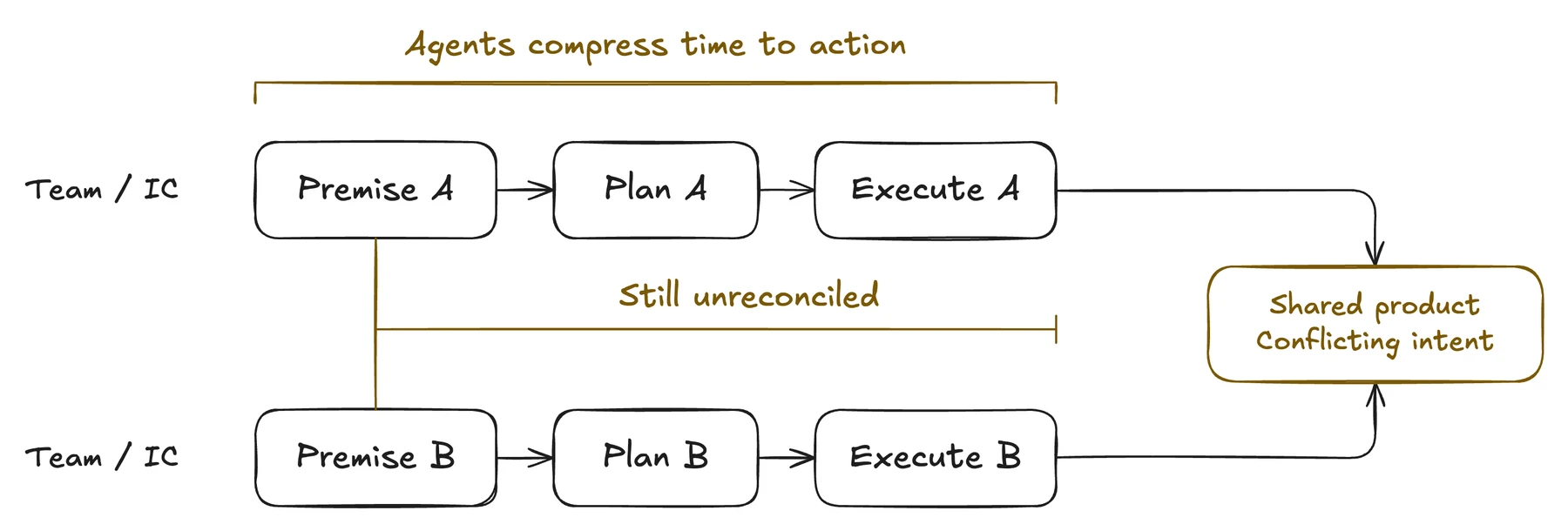
An individual contributor can now go from premise to working code before another team has even seen the plan. Both can ship good code while pursuing incompatible ideas about the same product.
Tests can pass while product direction conflicts. Reviewing the output alone does not reconcile the premises that led to it.
The missing step is shared understanding: what do we believe, whose decision is it, and does that decision still hold?
02 / Helen’s checks
Helen tests the premises behind the work.
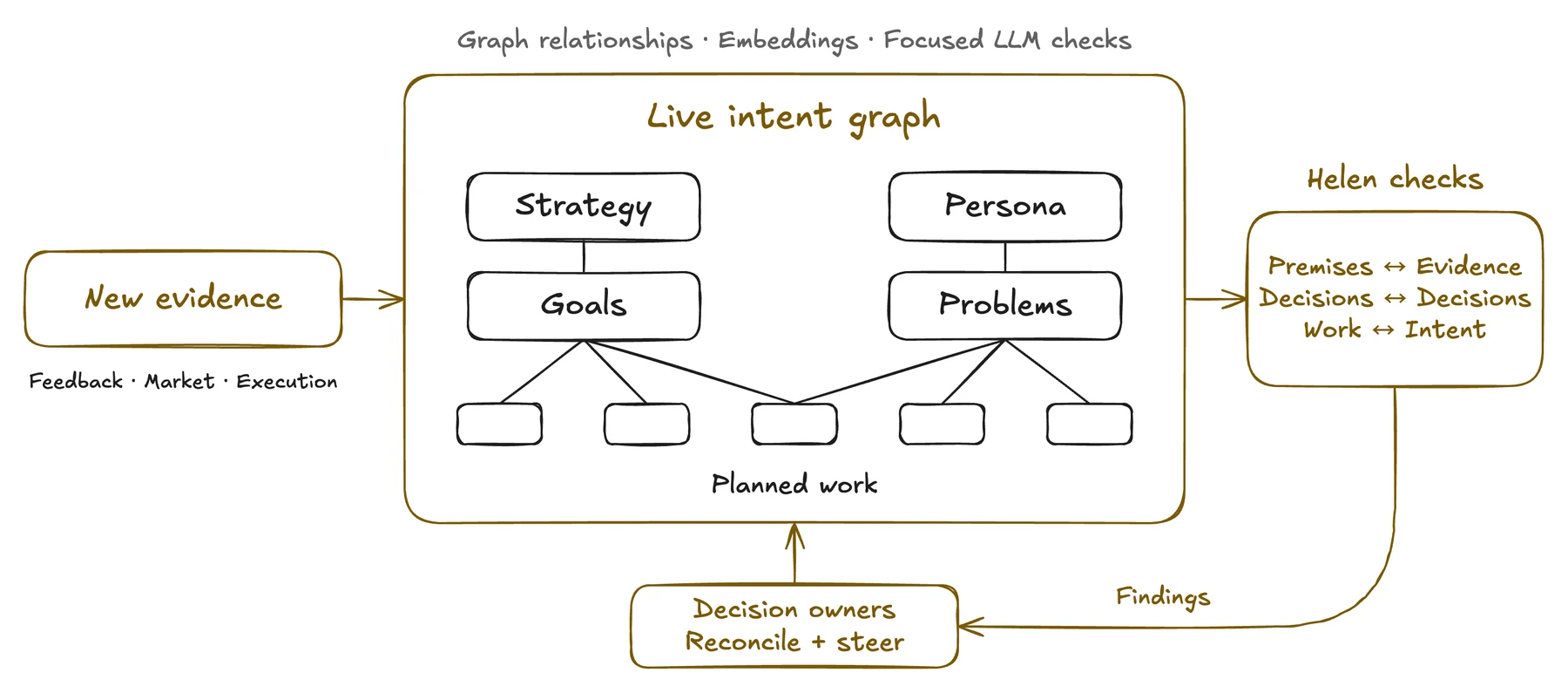
The live intent graph connects strategy and goals with personas, problems, and planned work. Feedback, bug reports, market changes, and execution evidence can challenge those connections.
- Premises against evidence
- Does new evidence challenge what we assumed?
- Decisions against decisions
- Are people directing work toward incompatible outcomes?
- Work against intent
- Does the work still follow the current direction?
Graph relationships supply context. Embeddings find candidates for comparison. Focused LLM checks assess the claims and evidence.
This is a forcing function for reconciliation. The graph is an imperfect model, and findings can be wrong. People challenge findings, adjust noisy checks, and decide what changes.
03 / Possible futures
The bitter lesson does not apply to roadmaps.
Our vision: models explore. Human taste sets direction.
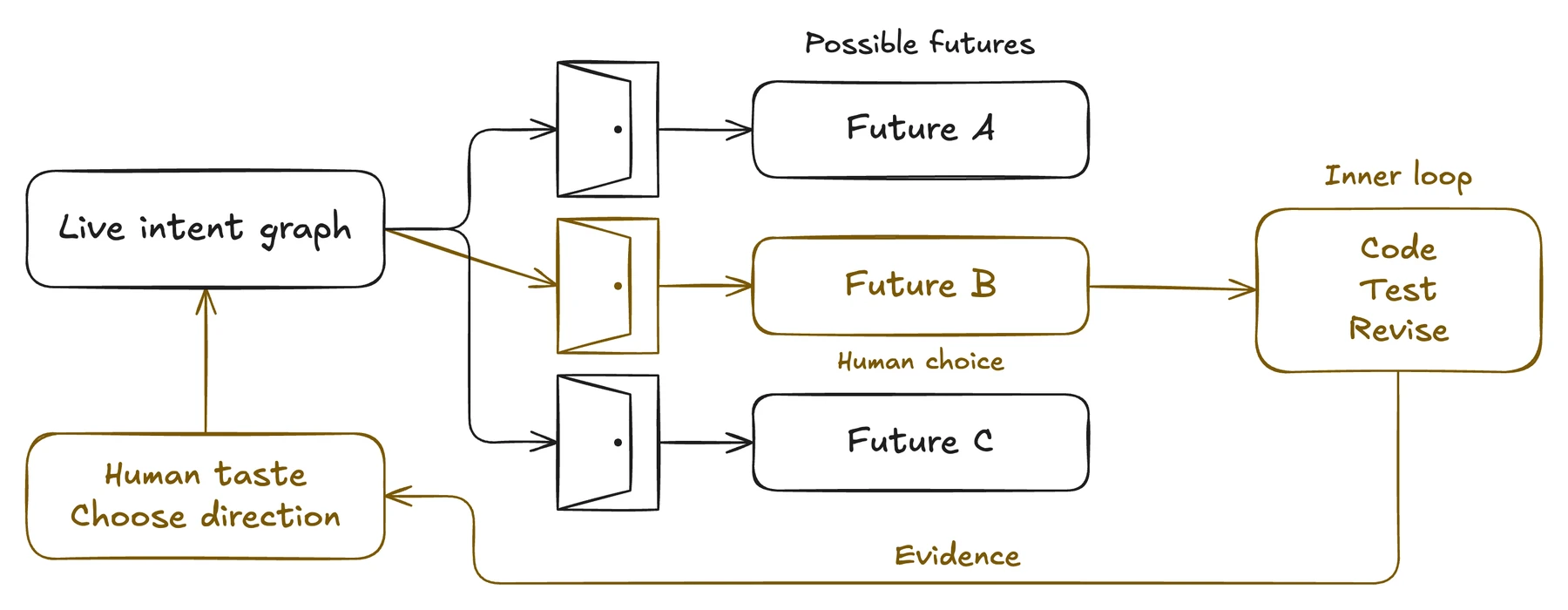
Our vision is to use shared intent to explore alternative plans before committing to one. Each possible future is a hypothesis to examine, with assumptions and consequences people can question.
Compute can help explore the possibilities. Human taste determines what is worth pursuing and reconciles competing priorities. More generation does not remove that responsibility.
The inner loop executes the chosen scenario: code, test, revise. Evidence returns to the next decision, alongside the record of why we chose a direction or left it behind.
Continuous checks and human reconciliation are in the product today. Richer scenario exploration is the direction we are building toward.
04 / Shared direction
Small teams. Many agents. Shared direction.
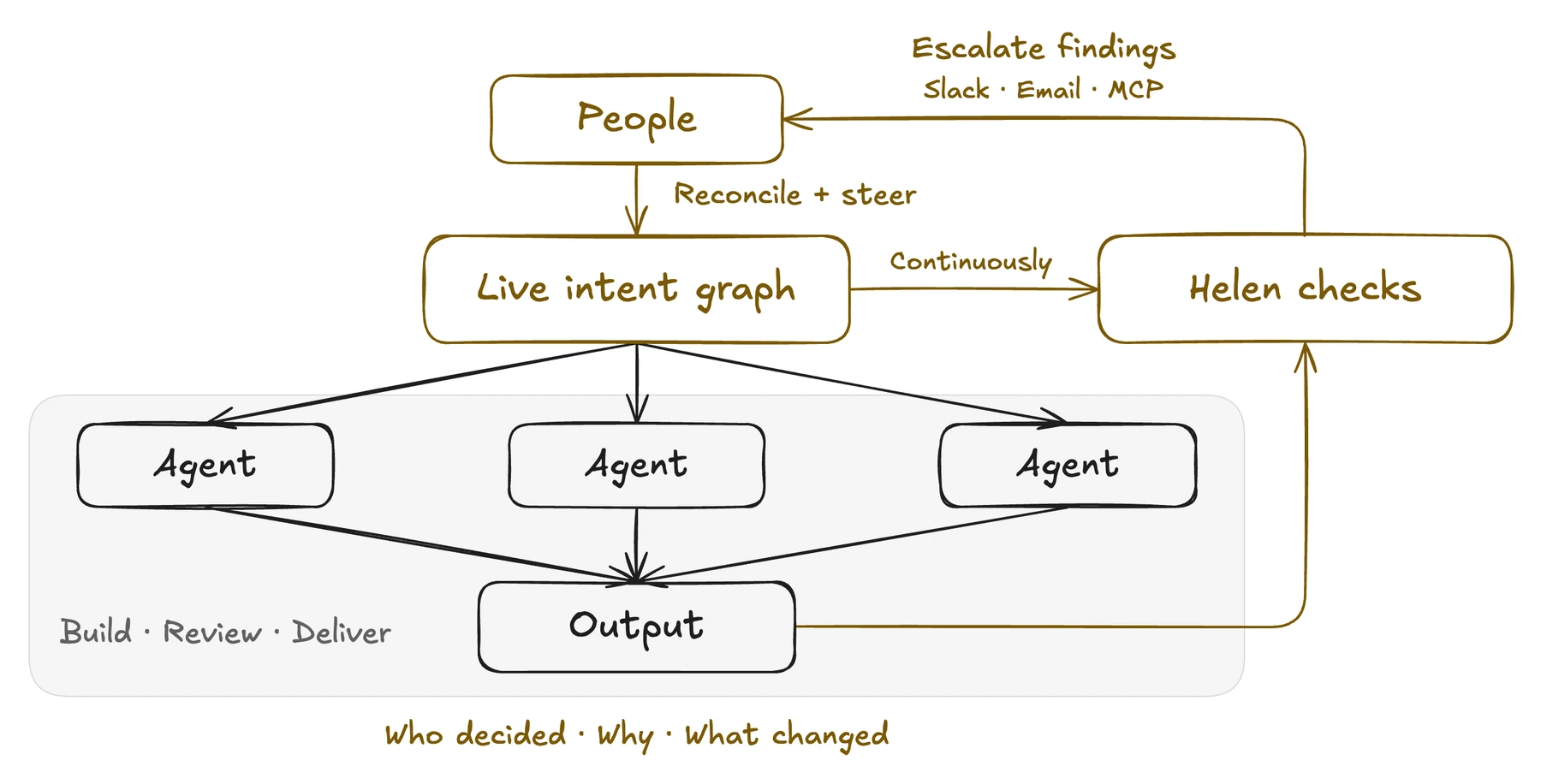
Much of the market improves building, reviewing, and delivering work. Helen checks that work against intent, and checks intent against itself. That is the outer loop.
Findings surface through Slack, email, and MCP, where people and agents already work. Urgency and notification preferences determine which alerts need attention and which can be grouped.
People reconcile and steer. The record keeps who decided, why, and what changed, so teams and agents can act on the updated direction.
MCP carries the decision context into agent work. The GitHub app checks linked changes against it. People retain the authority to change direction.
Bring your team’s real decisions.
Tell us where intent and execution lose touch. We’ll show you how Helen makes that conflict visible.